The AI Reality Check: When Hype Meets Economics

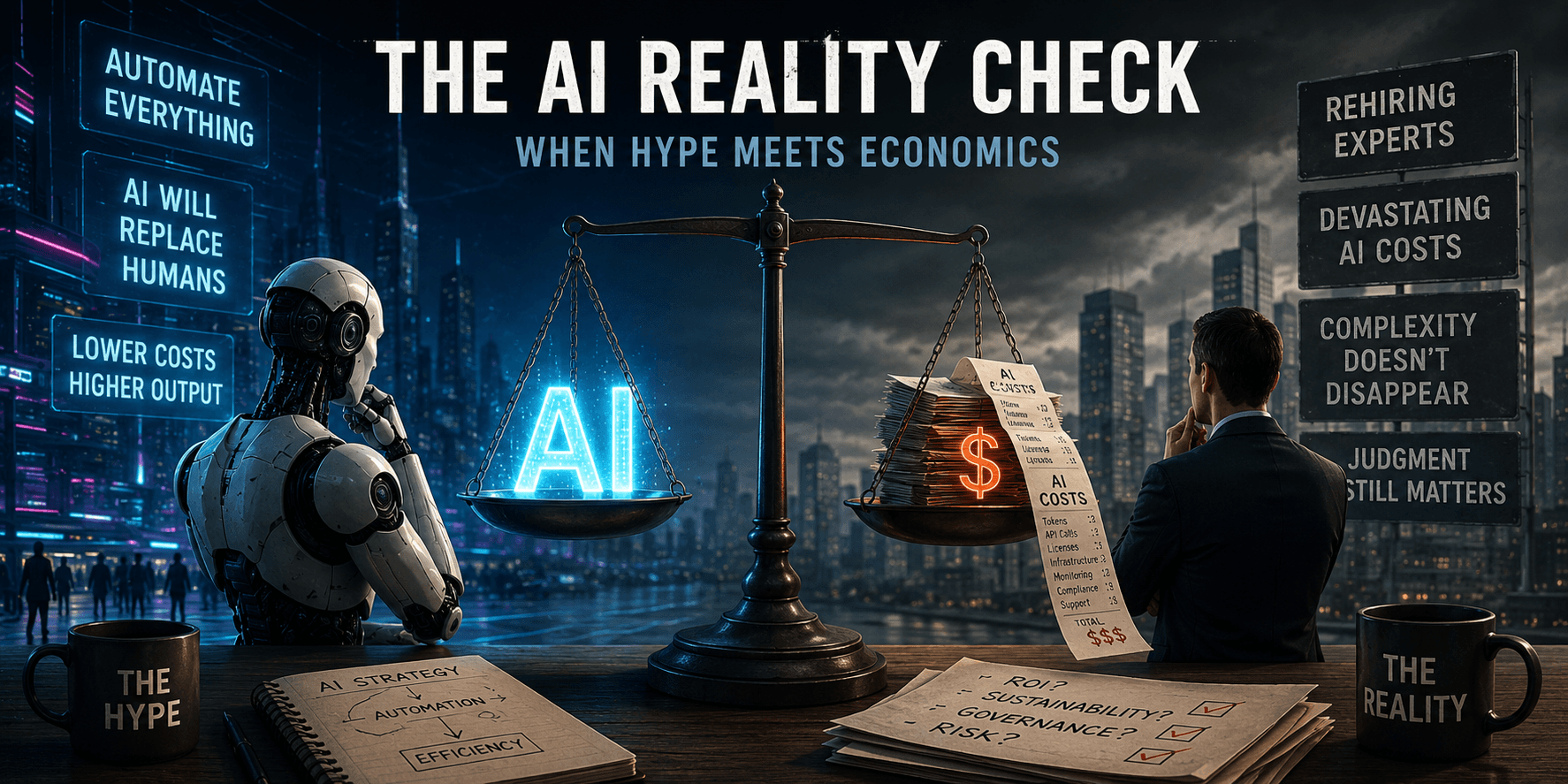
For the past two years, the technology industry has been dominated by a single narrative:
👉 AI will replace large portions of today's workforce.
Executives announced ambitious automation initiatives.
Investors rewarded AI-first strategies.
Companies rushed to integrate generative AI into products, customer support, software development, marketing, and business operations.
In some cases, organizations reduced headcount based on the assumption that AI would absorb a significant portion of the workload.
The future seemed obvious.
Then something interesting happened.
Reality arrived.
🤖 The AI Gold Rush
The rise of modern generative AI created a wave of optimism unlike anything we have seen since the early days of cloud computing.
Suddenly, tasks that previously required hours could be completed in minutes.
Code could be generated.
Documents could be summarized.
Marketing content could be created instantly.
Customer interactions could be automated.
The promise was compelling:
- Faster delivery
- Lower costs
- Smaller teams
- Higher productivity
And to be fair, AI delivered meaningful improvements in many areas.
The problem was not the technology.
The problem was the assumptions built around it.
🔄 The Quiet Rehiring Phase
Over the last year, stories have emerged of organizations quietly reversing earlier decisions.
Teams that had been reduced were rebuilt.
Specialists who were considered replaceable suddenly became necessary again.
Not because AI failed.
But because replacing knowledge work turned out to be far more complicated than generating content.
The challenge wasn't writing code.
The challenge was:
- understanding business context
- handling ambiguity
- making trade-offs
- owning outcomes
- managing risk
- coordinating across teams
AI can generate solutions.
Organizations still need people who understand whether those solutions are correct.
💰 The Cost Nobody Talked About
During the early AI adoption wave, most conversations focused on capability.
Very few focused on economics.
Initially, costs appeared manageable:
- small pilot programs
- experimentation budgets
- limited user groups
- proof-of-concept deployments
At enterprise scale, the picture changes dramatically.
Organizations now face:
- per-user licensing fees
- API consumption costs
- token usage charges
- retrieval infrastructure
- vector databases
- governance platforms
- monitoring systems
- compliance requirements
The result is simple:
👉 AI is not free labor.
AI is infrastructure.
And infrastructure costs money.
☁️ The New Cloud Moment
This situation feels surprisingly familiar.
Fifteen years ago, cloud computing promised unlimited scalability.
And it delivered.
But it also created a new discipline:
Cloud Financial Management.
Companies eventually learned that:
👉 Just because something is easy to consume doesn't mean it is inexpensive.
Many organizations experienced unexpected cloud bills after moving workloads without proper governance.
The same pattern is emerging with AI.
We are entering an era where organizations must think about:
- AI cost optimization
- model selection strategies
- workload placement
- usage governance
- ROI measurement
The AI conversation is gradually shifting from:
👉 "What can AI do?"
to:
👉 "What is AI costing us?"
🏗️ Architects Are Becoming AI Economists
Historically, architects optimized:
- scalability
- performance
- reliability
- maintainability
- security
Now another dimension is becoming increasingly important:
Cost per decision.
Every AI request has a price.
Every agent invocation has an economic footprint.
Every automated workflow consumes resources.
Architectural decisions increasingly determine whether AI initiatives remain financially sustainable.
The question is no longer:
👉 Can we build this with AI?
The question becomes:
👉 Should we?
⚠️ The Hidden Operational Burden
Another misconception is that AI reduces complexity.
In reality, it often shifts complexity elsewhere.
Organizations now need to manage:
- prompt engineering
- evaluation frameworks
- hallucination detection
- governance processes
- model upgrades
- compliance controls
- security reviews
- vendor lock-in risks
The technology is powerful.
The operational burden is real.
And unlike traditional software systems, many AI-powered workflows introduce a degree of unpredictability that teams must continuously monitor.
🧠 The Most Valuable Skill Remains Judgment
Perhaps the biggest lesson from the last two years is this:
👉 AI accelerates execution. It does not replace judgment.
The value of experienced professionals increasingly lies in:
- defining problems
- evaluating outcomes
- understanding trade-offs
- managing uncertainty
- making decisions under incomplete information
Ironically, these are the same skills that have always defined good architects.
As AI becomes more capable, the need for sound judgment becomes more—not less—important.
Because someone still needs to decide:
- which solution is correct
- which risk is acceptable
- which trade-off makes sense
- which investment creates value
📊 The Future Is Not AI vs Humans
The conversation was never supposed to be:
- AI or engineers
- AI or analysts
- AI or architects
The real question is:
👉 How do humans and AI work together effectively?
The most successful organizations are unlikely to be the ones that automate the most.
They will be the ones that understand:
- where AI creates value
- where human expertise remains essential
- where oversight is required
- where automation makes economic sense
This is not a technology challenge.
It is a business challenge.
🧭 Final Thoughts
AI is not disappearing.
Far from it.
It is becoming part of the foundation of modern software delivery.
But every transformative technology eventually encounters reality.
For cloud computing, that reality was cost.
For AI, it appears to be both cost and accountability.
The winners of the next phase will not be the organizations that adopt AI the fastest.
They will be the organizations that adopt it thoughtfully.
Because in technology, hype is temporary.
Sustainable value is not.
📚 Related Reading
- Agentic AI: Hype, Reality, and What It Means for Software Architects
- Is AI Replacing Software Engineers — Or Exposing Bad Architecture?
- Platform Engineering Is the New DevOps
☕ Support the blog → Buy me a coffee
No spam. Just real-world software architecture insights.