Architecture Knowledge: The Operating Model That Turns Architecture Into a Discipline

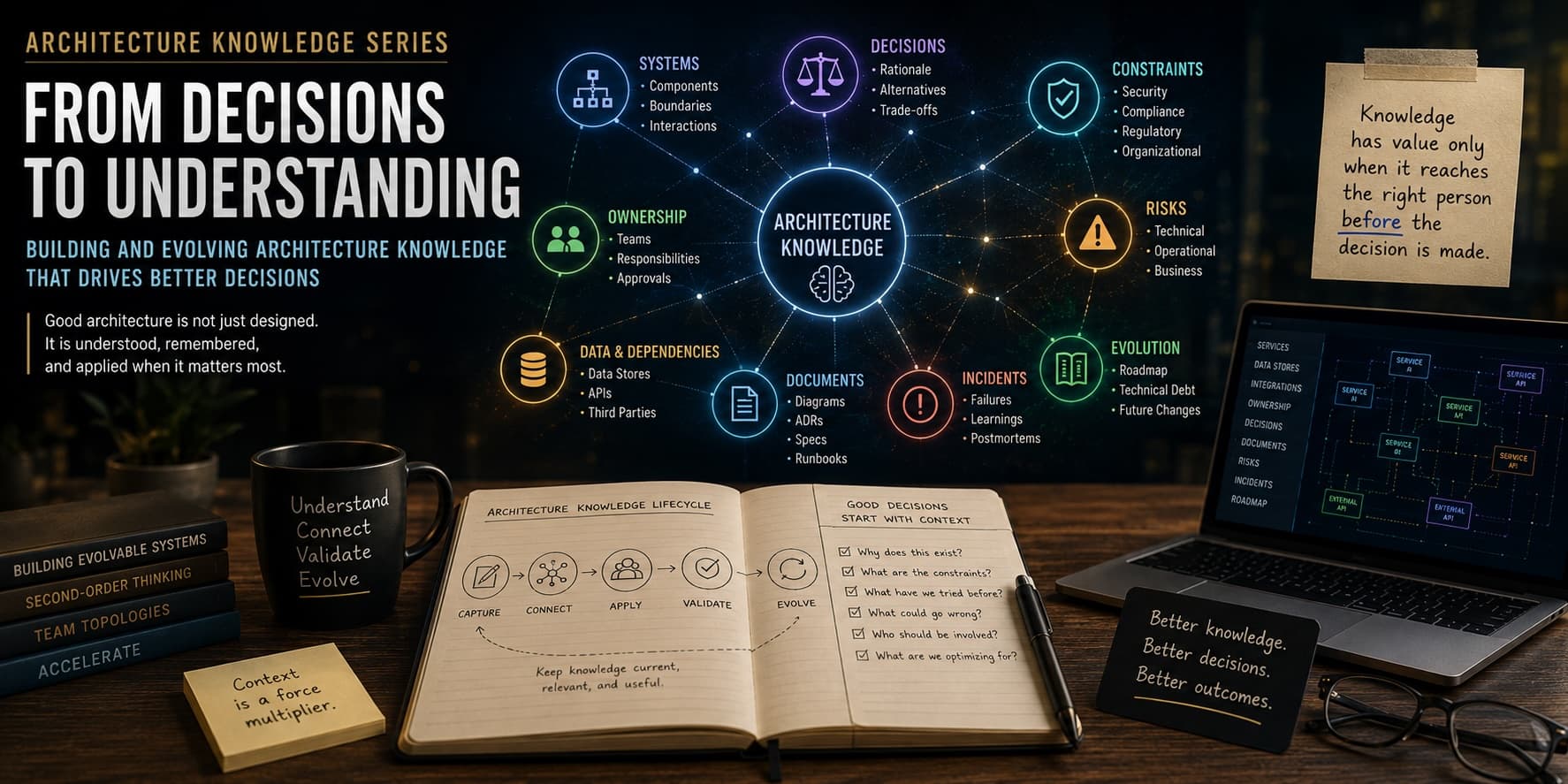
In the previous article, I argued that software architecture is not simply a collection of diagrams, ADRs, standards, and technology choices.
It is the organizational knowledge that allows systems to evolve safely.
That raises an obvious question:
"If architecture knowledge matters so much, how should organizations actually manage it?"
This is where things become difficult.
Because most organizations already have plenty of architectural information.
They have:
- diagrams
- ADRs
- documentation
- service catalogs
- standards
- incident reports
- design reviews
- internal wikis
The problem is rarely the absence of information.
The problem is that the information does not form a coherent operating model.
Architecture knowledge is created.
But it is not consistently:
- captured
- connected
- validated
- shared
- challenged
- retired
And without those mechanisms, architecture knowledge slowly turns into architecture archaeology.
🧠 Architecture Knowledge Needs an Operating Model
When people hear “knowledge management,” they often imagine repositories.
A central wiki.
A documentation portal.
A knowledge base.
But repositories are not operating models.
A repository answers:
“Where should we put information?”
An operating model answers:
“How does useful architectural knowledge move through the organization?”
That distinction matters.
Architecture knowledge should influence decisions while they are being made—not six months later when someone finds an old document.
The goal is therefore not to build the perfect architecture repository.
The goal is to create a system where relevant knowledge reliably appears at the moment it is needed.
🔄 The Architecture Knowledge Loop
A useful way to think about architecture knowledge is as a continuous loop.
flowchart LR
    A[Discover or Decide] --> B[Capture]
    B --> C[Connect]
    C --> D[Share]
    D --> E[Apply]
    E --> F[Validate]
    F --> G{Still valid?}
    G -->|Yes| C
    G -->|No| H[Update or Retire]
    H --> C
Every important architectural insight should eventually pass through these stages.
That does not mean every decision needs a formal process.
It means the organization needs mechanisms for architectural knowledge to remain useful over time.
1. Discover
Architecture knowledge is not created only during architecture reviews.
It emerges everywhere.
Examples include:
- production incidents
- performance investigations
- security reviews
- migrations
- failed experiments
- vendor evaluations
- code reviews
- customer escalations
Some of the most valuable architectural knowledge is learned when systems behave unexpectedly.
For example:
“This dependency cannot tolerate more than 500 concurrent connections.”
That insight may be more important than dozens of pages of architecture documentation.
The first responsibility of the operating model is therefore:
"Recognize where architecture knowledge is being created."
2. Capture
Once knowledge is discovered, some of it needs to be preserved.
But this is where organizations often overreact.
The answer is not:
“Document everything.”
That creates noise.
Instead, ask:
“Would losing this knowledge materially increase future decision risk?”
If the answer is yes, capture it.
Examples:
- important constraints
- architectural assumptions
- irreversible decisions
- significant failure modes
- non-obvious dependencies
- business-critical invariants
The goal is not comprehensive documentation.
The goal is minimum sufficient organizational memory.
3. Connect
This may be the most important—and most neglected—step.
Architectural information becomes much more valuable when it is connected to its context.
For example, an ADR should not exist in isolation.
It should relate to:
- the systems it affects
- the constraints behind it
- the risks it introduces
- the teams that own it
- the incidents that validate or challenge it
- the decisions that later supersede it
graph TD
    S[System] --> D[Decision]
    D --> C[Constraint]
    D --> R[Risk]
    S --> O[Owner]
    S --> I[Incident]
    I --> A[Assumption]
    A --> D
    D --> N[Later Decision]
Without these relationships, organizations accumulate documents.
With them, they begin to build architecture knowledge.
4. Share
Architecture knowledge that stays inside one team is local knowledge.
Sometimes that is enough.
Sometimes it creates risk.
The operating model needs to define which knowledge should cross boundaries.
Examples:
- shared security assumptions
- platform constraints
- enterprise integration patterns
- data ownership rules
- resilience expectations
- cross-service dependencies
The challenge is to avoid two extremes.
Extreme 1: Everything is local
Teams move quickly.
But the organization loses coherence.
Extreme 2: Everything is centralized
The organization gains consistency.
But architecture becomes a bottleneck.
A healthy operating model balances:
"Local ownership with shared visibility."
5. Apply
This is where architecture knowledge proves whether it has value.
The most important question is not:
“Do we have this documented?”
It is:
“Does this knowledge influence decisions?”
Architecture knowledge should naturally appear during:
- solution design
- technology selection
- API design
- pull-request review
- incident response
- security assessment
- capacity planning
- decommissioning
If teams must actively remember that knowledge exists before they can search for it, the system is already failing.
Useful architecture knowledge should be brought into the decision flow.
6. Validate
Architecture knowledge decays.
Some of it decays slowly.
Some becomes obsolete almost immediately.
Examples:
Slowly changing
- business invariants
- regulatory constraints
- strategic domain boundaries
Rapidly changing
- service ownership
- deployment topology
- vendor capabilities
- cost assumptions
- capacity limits
This means architectural knowledge cannot simply be captured and forgotten.
It must occasionally be challenged.
Ask:
- Is this still true?
- Has the environment changed?
- Has a recent incident invalidated this assumption?
- Does the original rationale still apply?
Architecture knowledge should be treated as:
"Current understanding—not eternal truth."
7. Retire
This is one of the least glamorous but most important disciplines.
Old architecture knowledge can be dangerous.
Imagine discovering an ADR that says:
“Kafka must never be used for this capability.”
But the document was written six years ago because of a platform limitation that no longer exists.
Without lifecycle management, old decisions quietly become permanent rules.
Knowledge needs explicit states such as:
- proposed
- active
- challenged
- superseded
- retired
Historical knowledge should remain available.
But it should not pretend to be current.
🏗️ Who Owns Architecture Knowledge?
This is where operating models often fail.
If architecture knowledge belongs only to architects, architects become bottlenecks.
If nobody owns it, knowledge decays.
The answer is distributed ownership.
Different people own different forms of knowledge.
| Knowledge | Likely owner |
|---|---|
| Service behavior | Engineering team |
| Business capability | Product/domain team |
| Architecture decisions | Decision participants |
| Platform constraints | Platform team |
| Security rules | Security team |
| Operational lessons | Engineering/SRE |
| Cross-system context | Architects |
Architects should not own every piece of knowledge.
Their responsibility is to help ensure the knowledge remains:
- connected
- coherent
- discoverable
- useful across boundaries
🧭 Architects as Knowledge Curators
This suggests a different interpretation of the architect’s role.
Architects are often described as:
- system designers
- reviewers
- governance authorities
- technology strategists
But another role may be just as important:
"Knowledge curator."
A good architect continuously asks:
- What does this team know that others need to know?
- Which assumption is hidden?
- Which decision lacks context?
- Which architecture artifact is stale?
- Which failure taught us something important?
- Which knowledge exists only in one person’s head?
The architect’s job is not simply to create architecture knowledge.
It is to improve how architecture knowledge flows.
⚠️ Don’t Turn This Into Governance Theater
There is an obvious danger.
Once organizations recognize architecture knowledge as important, they may create:
- mandatory templates
- approval committees
- document checklists
- centralized repositories
- additional review gates
Soon, architecture knowledge becomes bureaucracy.
The operating model should instead be proportional.
A useful rule:
quadrantChart
    title Knowledge rigor
    x-axis Easy to reverse --> Difficult to reverse
    y-axis Low impact --> High impact
    quadrant-1 Deep capture and review
    quadrant-2 Capture key risks
    quadrant-3 Lightweight and local
    quadrant-4 Record rationale
A reversible internal implementation choice may need almost no formal capture.
A decision that affects:
- customer data
- regulatory compliance
- public APIs
- strategic platform direction
deserves much stronger knowledge preservation.
Architecture discipline should increase with consequence.
Not with organizational anxiety.
📉 Measure Friction, Not Documentation Volume
Another common mistake is measuring architecture knowledge by output.
For example:
- number of ADRs
- number of diagrams
- percentage of services documented
Those metrics can easily become vanity metrics.
A better question is:
"How expensive is it to answer important architectural questions?"
For example:
- How long does it take to identify who owns a service?
- How long does it take to understand why a technology was chosen?
- Can teams identify downstream impact before making a change?
- How often are decisions revisited because previous reasoning cannot be found?
- How dependent are we on specific individuals for architectural context?
These measures reflect decision friction.
And reducing decision friction is one of the strongest reasons to manage architecture knowledge intentionally.
🧩 Architecture Knowledge and Team Boundaries
Conway’s Law tells us that systems reflect organizational communication structures.
Architecture knowledge behaves similarly.
Teams that rarely communicate develop isolated interpretations of the architecture.
Over time:
- terminology diverges
- assumptions diverge
- patterns diverge
- duplicate capabilities appear
Architecture knowledge therefore needs intentional bridges across organizational boundaries.
Those bridges may include:
- architecture communities
- engineering forums
- shared design reviews
- platform documentation
- cross-team retrospectives
- technical guilds
The mechanism matters less than the outcome.
The organization must periodically synchronize its understanding of itself.
🧠 The Goal Is Not a Single Source of Truth
This phrase appears constantly in knowledge-management discussions:
“We need a single source of truth.”
I think that goal is often unrealistic.
Complex organizations naturally have multiple authoritative sources.
For example:
- Git may be authoritative for code
- a service catalog for ownership
- an ADR repository for decisions
- an observability platform for runtime behavior
Trying to copy everything into one system usually creates another synchronization problem.
A stronger goal is:
"A connected source of understanding."
The information can remain distributed.
The relationships should not.
🌱 Start Small
Organizations do not need a large transformation initiative.
Start with five questions.
Pick an important system and ask:
- Why does this system exist?
- Who owns it?
- Which decisions shaped it?
- Which constraints matter?
- What have we learned from operating it?
If answering those questions requires:
- multiple meetings
- several Slack searches
- finding a particular senior engineer
then you have identified an architecture knowledge problem.
Improve those pathways first.
Then expand.
🧭 Final Thoughts
Architecture knowledge does not become valuable because it is documented.
It becomes valuable because it participates in decisions.
That requires an operating model.
A healthy organization continuously:
- discovers knowledge
- captures what matters
- connects it to context
- shares it appropriately
- applies it during decisions
- validates its relevance
- retires it when necessary
This is not documentation management.
It is organizational memory engineering.
And I increasingly believe it deserves to be treated as a first-class architectural discipline.
Because architecture decisions do not fail only because engineers make bad choices.
They also fail because people make reasonable choices without access to the knowledge their organization already possesses.
The goal of Architecture Knowledge is therefore surprisingly simple:
"Put the right context in front of the right people before an important decision is made."
Everything else is implementation.
📚 Architecture Knowledge Series
Coming Next
- Why Architecture Documentation Becomes Stale
- Tacit Architecture Knowledge: What Diagrams Cannot Capture
- Architecture Knowledge Graphs
- Decision Latency: The Hidden Cost of Fragmented Knowledge
- Architecture Knowledge Without Bureaucracy
☕ Support the blog → Buy me a coffee
No spam. Just real-world software architecture insights.