Failover Is Harder Than It Looks

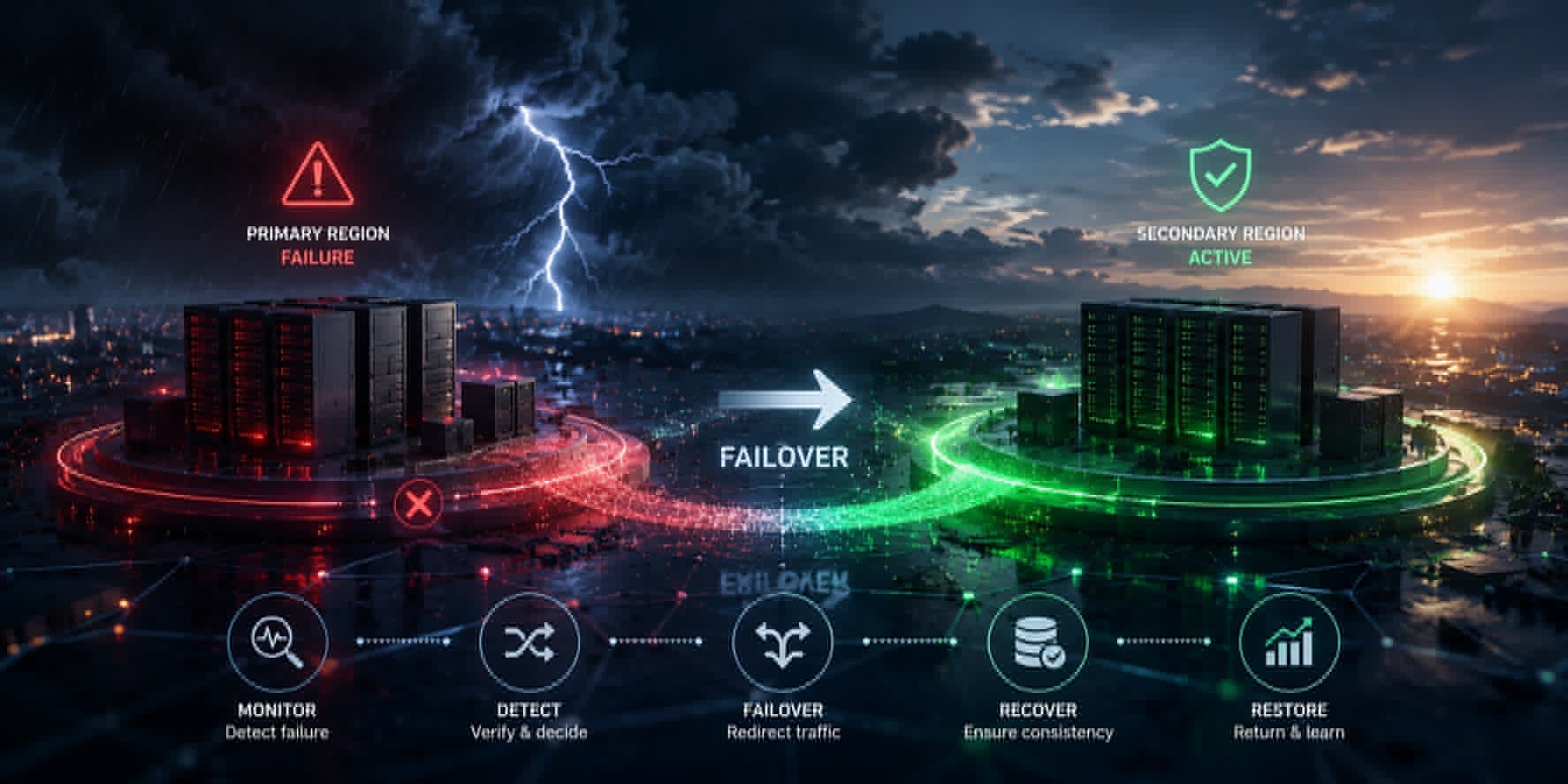
When architects discuss resilience, failover is usually one of the first strategies mentioned.
“Don’t worry — we have failover.”
Secondary databases.
Multi-region deployments.
Backup clusters.
Redundant services.
On paper, everything looks safe.
But production incidents repeatedly remind us of a difficult truth:
👉 Most failovers work perfectly — until the day you actually need them.
Because failover is not just about redundancy.
It’s about transitioning a live system from a broken state into a stable one — under stress, uncertainty, and often incomplete information.
And that’s much harder than architecture diagrams suggest.
🔄 Redundancy Is the Easy Part
Creating a backup system is relatively straightforward.
Cloud providers make it almost trivial:
- secondary regions
- replicated databases
- load balancer failover
- multi-AZ deployments
The hard part is:
- synchronization
- consistency
- coordination
- recovery behavior
A standby environment is not useful if:
- data is stale
- dependencies are unavailable
- DNS propagation is delayed
- applications cannot reconnect properly
The failover path itself becomes part of the system architecture.
⚠️ The Dangerous Assumption: “The Backup Is Ready”
One of the biggest problems with failover strategies is psychological.
Teams assume:
👉 “If the primary fails, the secondary will simply take over.”
Reality is usually messier.
Common issues include:
- replication lag
- configuration drift
- expired credentials
- stale caches
- untested automation
- hidden dependency coupling
The secondary environment often receives far less real traffic than production.
Which means:
👉 the first true production test happens during an actual outage.
That’s not resilience.
That’s optimism.
🌍 Multi-Region Doesn’t Automatically Mean Resilient
A common misconception:
👉 “We run in multiple regions, therefore we are highly available.”
Not necessarily.
Many multi-region systems still depend on:
- centralized authentication
- shared databases
- global control planes
- common DNS providers
- shared CI/CD systems
In other words:
- infrastructure may be distributed
- failure domains often are not
Architecturally, true resilience requires:
👉 independent failure boundaries.
🧠 Active-Passive vs Active-Active
Failover discussions usually lead to this trade-off.
💤 Active-Passive
One environment handles traffic.
The other waits.
✅ Advantages
- simpler consistency model
- easier operational reasoning
- lower complexity
❌ Challenges
- passive systems drift over time
- slower failover
- hidden configuration issues
- less production validation
⚡ Active-Active
Both environments handle traffic simultaneously.
✅ Advantages
- continuous validation
- faster recovery
- better resource utilization
❌ Challenges
- data consistency
- split-brain scenarios
- conflict resolution
- operational complexity
Active-active architectures sound attractive.
But they are significantly harder to implement correctly.
🧨 Split Brain: One of the Most Dangerous Failure Modes
One of the worst outcomes during failover is split brain.
This happens when:
- two systems both believe they are primary
- both continue accepting writes
- state diverges independently
The result:
- conflicting data
- corruption
- difficult reconciliation
- unpredictable system behavior
Avoiding split brain requires:
- strong coordination mechanisms
- quorum strategies
- careful leader election design
Distributed systems become hardest precisely when communication is unreliable.
Which is exactly when failovers happen.
🌐 DNS Failover Is Not Instant
Many architectures rely on DNS failover.
But DNS introduces its own realities:
- TTL caching
- propagation delays
- client-side DNS behavior
- stale records
During incidents, teams often discover:
👉 “The failover technically worked — but users still reached the dead system.”
Because the internet itself is eventually consistent.
🔍 The Biggest Problem: Untested Failover Paths
The uncomfortable truth:
Many failover mechanisms are never fully tested.
Why?
- fear of disruption
- operational complexity
- production risk
- lack of confidence
But resilience cannot be assumed.
If failover paths are not exercised regularly:
- automation decays
- assumptions become outdated
- hidden coupling accumulates
Eventually:
👉 the recovery system becomes less reliable than the failure itself.
🛠 What Good Architects Do Differently
Thoughtful resilience design includes:
✅ Regular failover testing
Not theoretical exercises — real operational validation.
✅ Dependency mapping
Understanding hidden shared dependencies.
✅ Clear recovery objectives
- RTO (Recovery Time Objective)
- RPO (Recovery Point Objective)
✅ Graceful degradation
Not every failure requires full failover.
✅ Failure isolation
Limiting blast radius across regions and services.
✅ Operational simplicity
Because complexity becomes the enemy during incidents.
🧭 Failover Is an Organizational Problem Too
Technology alone doesn’t solve failover challenges.
Recovery also depends on:
- communication
- incident response
- decision-making clarity
- operational readiness
The best failover architecture in the world can still fail if:
- teams panic
- ownership is unclear
- procedures are outdated
Resilience is both:
- technical
- organizational
🧠 Final Thoughts
Failover sounds simple in architecture presentations.
Reality is different.
The real challenge is not building backup systems.
It’s ensuring they:
- remain synchronized
- behave predictably
- fail safely
- recover consistently
- and continue working under stress
Because resilience is not measured by how systems behave when everything works.
It’s measured by what happens:
👉 when the primary system disappears unexpectedly at 3 AM.
And that’s when architecture becomes very real.
📚 Related Reading
- Retries, Timeouts, and Circuit Breakers
- The Architecture Behind Outages: Why Big Systems Keep Failing
- Platform Engineering Is the New DevOps
☕ Support the blog → Buy me a coffee
No spam. Just real-world software architecture insights.