Java4Shell: What AI Changes About Vulnerability Research

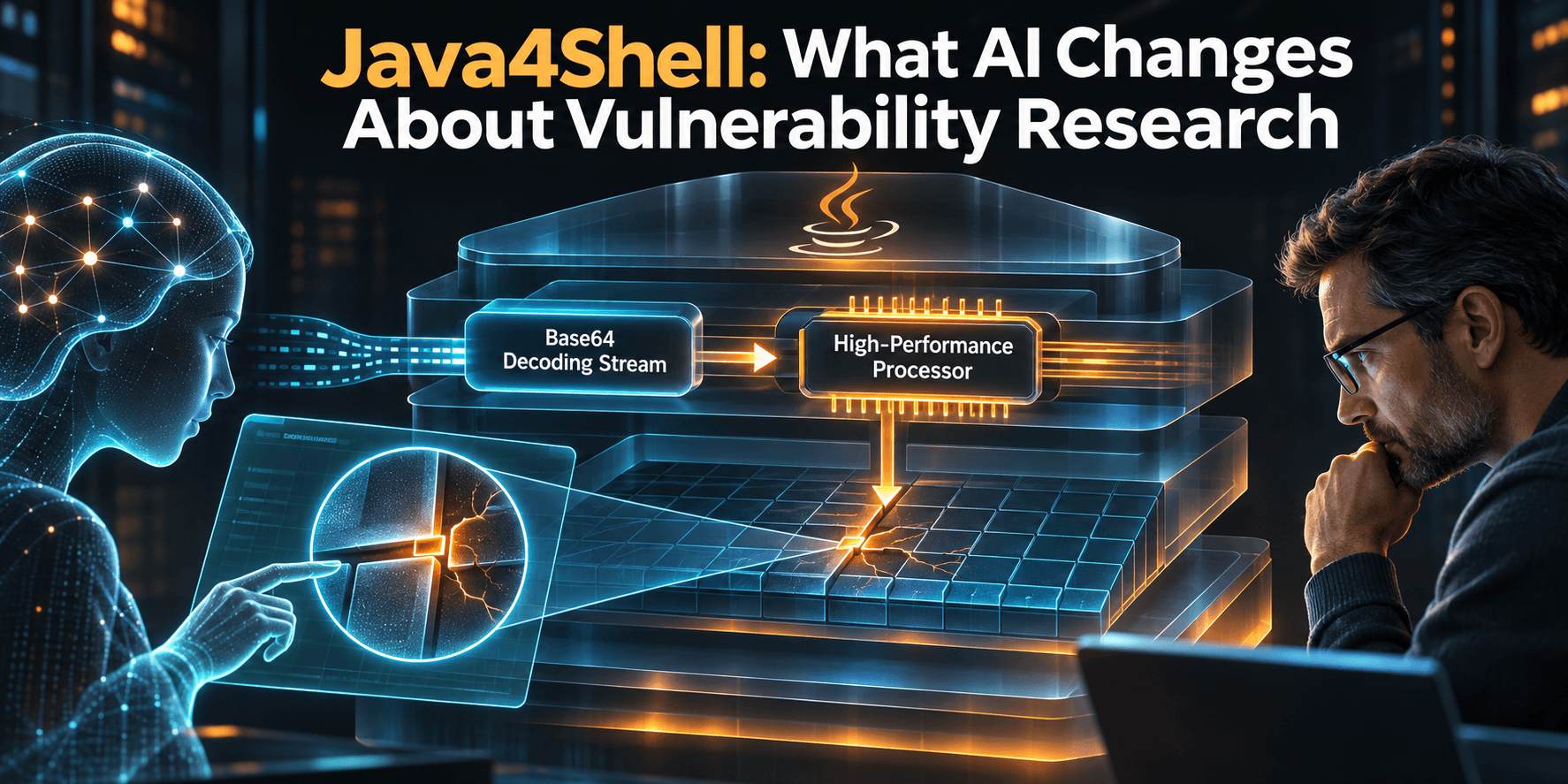
Java has a reputation for memory safety.
The runtime manages memory for application developers. It checks array bounds. It prevents many of the corruption bugs that are routine in lower-level systems code.
That reputation is deserved—but it has a boundary.
The Java Virtual Machine itself contains native code, compiler optimizations, and hand-written assembly. Those parts do not become memory-safe just because the applications running above them are written in Java.
Java4Shell is a recent reminder of that boundary. It is also a striking example of how AI is changing the economics of vulnerability research.
The important story is not simply that an AI found a bug. It is how a researcher used AI to investigate a mature codebase, recognize a promising result among many weak ones, and then continue validating what the finding could mean.
What Java4Shell Is
Java4Shell, tracked as CVE-2026-114938, is a memory corruption flaw in an optimized Base64 decoder in OpenJDK’s HotSpot runtime. Under specific conditions, malformed input can make the decoder write beyond the end of an allocated buffer.
The affected path is hardware-specific. The public advisories describe exposure on certain x86-64 systems with AVX-512 VBMI support and affected, unpatched Java builds. ARM64 systems and processors without the required instruction support are not known to be affected. The exact scope depends on the Java distribution, version, hardware, and how an application reaches the decoder.
That distinction matters. A flaw in a widely used runtime does not mean every Java service is automatically exploitable. But Base64 decoding appears in ordinary application paths such as authentication, tokens, and file handling. If untrusted data can reach the vulnerable path, a low-level runtime defect can become an application-level risk.
The researcher demonstrated that this memory corruption could be developed into more serious outcomes in particular applications. That work required application-specific conditions and exploitation techniques; there is no single universal exploit that applies to every Java service.
This is why the incident deserves attention from architects as well as vulnerability researchers. A component can be present throughout a system without appearing in the application’s own code, and its risk depends on the entire path from input to runtime behavior.
The Discovery Was Fast. The Work Was Not Just a Prompt.
According to the researcher’s account, Quang Luong directed Codex to investigate areas of OpenJDK such as the JIT compiler, intrinsics, widely accessible APIs, and cryptography. The early suggestions included false positives and findings that were not realistically exploitable. After continued investigation, the model surfaced a memory corruption issue in the Base64 decoder. The researcher reports about an hour to find it and two more hours to produce the first working exploit.
That is a remarkable compression of time. It is not evidence that an unattended model independently audited OpenJDK and delivered a verified vulnerability.
The researcher chose where to look. They supplied context, evaluated suggestions, rejected weak leads, and decided when a result deserved deeper analysis. AI helped search a difficult codebase and reason across implementation details. Human expertise kept that exploration directed and separated a real defect from a plausible-sounding answer.
The distinction matters because vulnerability research has several different stages:
- Find a suspicious behavior. A model may help inspect code, compare paths, or suggest edge cases.
- Establish that it is reachable. Someone must determine whether the relevant code can actually execute under realistic conditions.
- Prove the impact. A memory error is not automatically remote code execution. The consequences depend on surrounding code, runtime state, and attacker control.
- Report and fix it responsibly. Maintainers need a clear reproduction, affected versions, and a safe path to remediation.
AI can contribute at every stage. It does not make those stages interchangeable.
Why This Kind of Bug Can Hide in Mature Software
The vulnerable code was not an ordinary Java method. It was a specialized, high-speed implementation used by HotSpot under particular hardware and runtime conditions.
Optimized code often crosses several boundaries at once:
- a high-level API promises certain behavior
- a JIT compiler decides when to replace general code with a specialized path
- an intrinsic maps an operation to low-level instructions
- CPU features affect which implementation runs
- buffer sizing and malformed input interact at the edges
Each layer can be reasonable on its own. Bugs appear in the details where their assumptions meet.
This is a familiar architecture problem. System behavior is not determined only by the component we designed. It also depends on runtime libraries, hardware capabilities, configuration, and the way upstream inputs flow through them.
The issue also shows why “the code has existed for years” needs careful handling. Public advisories identify affected versions, but that range does not establish the exact date the defect entered the codebase. I have not found a primary source confirming that Java4Shell itself was present for twelve years. The safer conclusion is narrower: a subtle flaw in a mature, heavily reused runtime path escaped detection until a focused AI-assisted audit brought it to light.
AI Changes the Cost of Looking
For years, deep code audits have been constrained by the amount of expert time available. Large codebases contain more paths, variants, and platform-specific behavior than any one person can inspect line by line.
AI changes that constraint. It can help researchers navigate unfamiliar code, generate hypotheses, trace behavior across files, and quickly test variations. A specialist can spend less time on mechanical exploration and more time deciding which questions matter and which results survive scrutiny.
The practical shift is not “AI does security research.” It is that a skilled researcher can now ask more questions of a codebase, iterate faster, and afford to investigate corners that might otherwise remain untouched.
This also changes the defensive calculation. If researchers can examine mature software more cheaply, defenders may be able to review more of their own dependencies and internal systems. But the same capabilities are available to attackers. The time between finding a weakness and attempting to exploit it may shrink as well.
Discovery speed is only one side of the equation. Organizations still need a way to:
- identify which products and runtime builds they actually operate
- understand whether affected hardware features are exposed to the JVM
- assess whether untrusted input reaches the vulnerable operation
- prioritize upgrades or mitigations
- verify that fixes reach every environment, including less visible workloads
When analysis accelerates, inventory and response can become the slower part of security.
Architecture Has a Role in Reducing the Blast Radius
Java4Shell is a runtime vulnerability, so no application architecture can guarantee immunity from defects below it. Still, architecture influences how much exposure a defect creates and how quickly teams can respond.
Useful questions include:
- Do we know which services run which JDK distributions and versions?
- Can we trace a public input path to sensitive runtime operations?
- Are services exposed directly, or behind controls that reduce reachable inputs?
- Can a runtime update be deployed independently of a full application redesign?
- Do we have enough test coverage and rollout safety to patch quickly?
- Can we disable an optimization or isolate a workload temporarily if a patch is delayed?
These questions connect software architecture to software supply chain and operational readiness. A runtime is a dependency even when teams do not think of it as one. Its version, hardware assumptions, and patch cadence belong in the system’s operational knowledge.
The strongest response is still to apply vendor fixes for affected deployments. Mitigations such as disabling the affected Base64 intrinsics or limiting AVX usage are temporary measures that need to be checked against the relevant vendor guidance and workload impact.
The More Interesting Question: What Can We Remove?
Java4Shell also points to a broader design tension.
Shared platforms accumulate capabilities over time. Some are essential. Some are used by only a fraction of applications. Yet every shipped code path becomes part of the surface that must be reviewed, tested, secured, and maintained.
Removing a feature is not automatically safer. A feature that appears unused may have hidden consumers, and removing it can introduce compatibility problems of its own. But AI may lower the cost of mapping how a capability is used across a large system. That can make a previously expensive question more practical:
“Which complexity do we still need to carry?”
This is not a call to strip systems indiscriminately. It is a reason to treat unnecessary complexity as an architectural and security concern—and to make evidence-based removal part of the conversation when maintaining shared platforms.
Final Thoughts
Java4Shell is serious because a low-level defect in a common runtime can become reachable through ordinary application behavior. It is notable because AI helped a researcher find and investigate a flaw in a codebase that has been examined for decades.
The lesson is not that AI makes experts unnecessary. It is that expert-led investigation can now cover more ground, and that the volume of possible findings may grow faster than organizations’ ability to understand and fix them.
For engineering leaders and architects, that raises two responsibilities:
- Make critical dependencies, runtime versions, and input paths visible enough to assess quickly.
- Use AI to expand review and validation, while keeping people accountable for evidence, impact, and remediation.
AI can make it cheaper to look for hidden defects. Good architecture and operations determine whether we can understand the exposure, contain the risk, and learn from what was found.
The next security advantage may come from asking both questions:
“What can we find faster?”
And:
“What can we simplify so there is less to find?”
Sources
- Java4Shell technical disclosure by Calif
- OpenJDK Vulnerability Advisory: 2026/11/17
- Red Hat security advisory RHSB-2026-018
- Oracle Critical Security Patch Update Advisory: November 2026
☕ Support the blog → Buy me a coffee
No spam. Just real-world software architecture insights.