Vibe Coding vs Context Engineering vs Spec-Driven Development vs Autonomous Development Agents

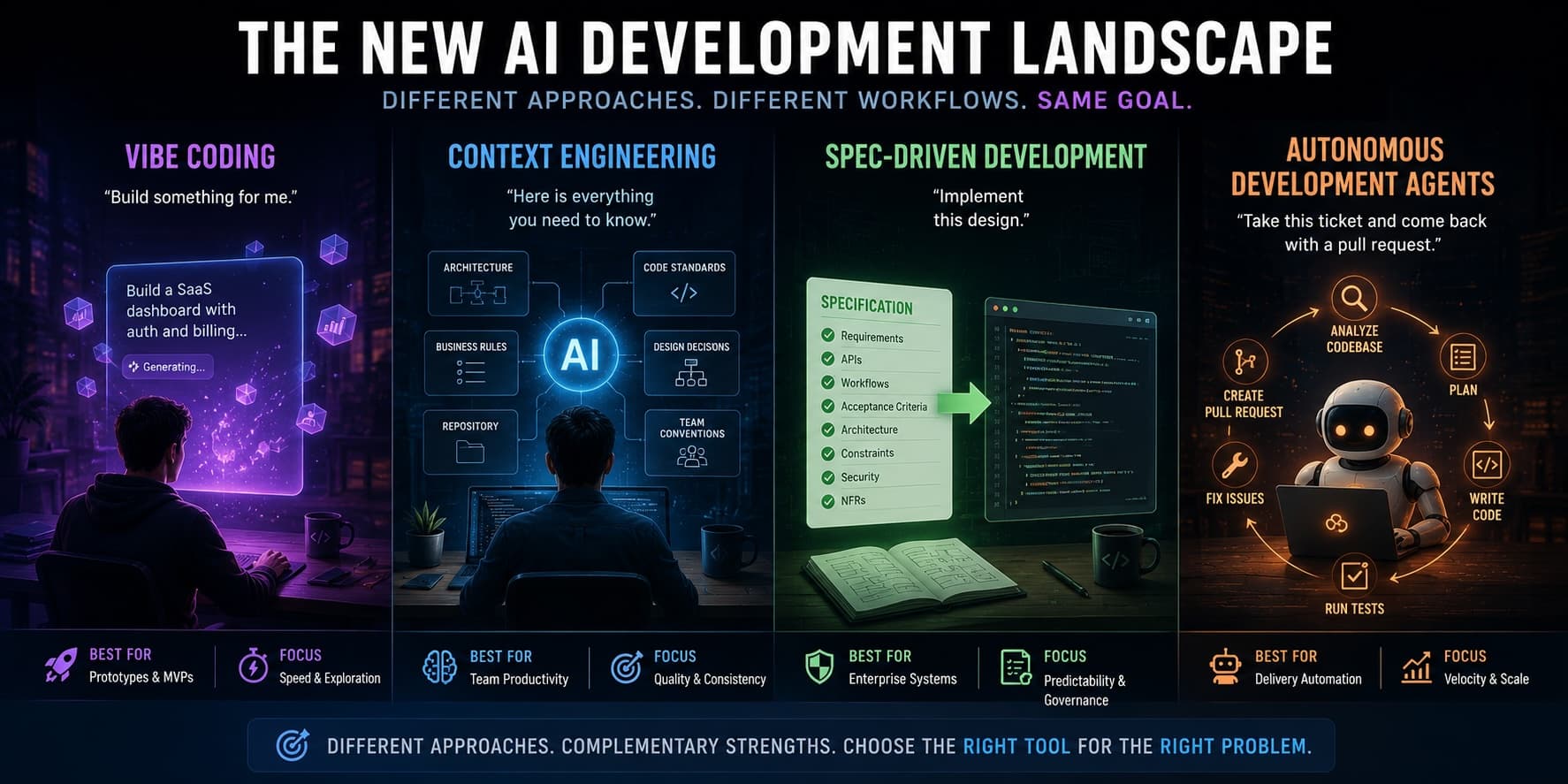
Over the last two years, AI has fundamentally changed software development.
But something interesting has happened.
The industry has started creating new terms almost as fast as it creates new tools:
- Vibe Coding
- Context Engineering
- Spec-Driven Development
- Autonomous Development Agents
Depending on who you ask, these concepts are either the future of software engineering or simply new labels for old practices.
The reality is somewhere in between.
While they all leverage AI, they represent very different ways of building software.
Understanding those differences is becoming increasingly important for architects, engineering leaders, and development teams.
🤔 Why So Many New Terms?
Historically, software development followed a relatively predictable flow:
Requirements → Design → Development → Testing → Deployment
Generative AI has disrupted this model.
Instead of writing everything manually, engineers can now:
- generate code
- generate tests
- generate documentation
- generate architectures
- generate entire applications
The question is no longer:
👉 "Can AI write code?"
The question has become:
👉 "How should humans collaborate with AI to build software effectively?"
The four approaches emerging today represent different answers.
🎸 Vibe Coding
Vibe Coding is perhaps the most discussed—and controversial—approach.
The concept is simple:
👉 Describe what you want and let AI figure out the implementation.
The developer acts more like a director than an engineer.
Examples:
- "Build me a SaaS application with authentication and subscriptions."
- "Create a dashboard showing sales trends."
- "Build a mobile app for expense tracking."
The AI generates most of the code.
The human reviews, tweaks, and iterates.
Advantages
- Extremely fast prototyping
- Low barrier to entry
- Ideal for experimentation
- Great for MVPs
Challenges
- Architecture often emerges accidentally
- Limited maintainability
- Difficult to scale
- Hidden technical debt
Many successful demos are built using vibe coding.
Far fewer production platforms are.
Typical Tools
- ChatGPT
- Claude
- Lovable
- Bolt.new
- v0
- Replit AI
🧠 Context Engineering
Context Engineering emerged as teams realized something important:
👉 The quality of AI output depends heavily on the quality of context.
Instead of focusing on prompts, developers focus on supplying:
- architecture documents
- coding standards
- business rules
- repository structure
- design decisions
- ADRs
- team conventions
The goal is to help AI make better decisions.
In many ways:
👉 Context is becoming the new source code.
Advantages
- Higher quality output
- Better consistency
- Improved maintainability
- Better architectural alignment
Challenges
- Requires significant preparation
- Context becomes difficult to manage
- Documentation must remain current
- Organizational discipline is required
Typical Tools
- Claude Projects
- Cursor
- Windsurf
- OpenAI Projects
- Continue.dev
- Sourcegraph Cody
📋 Spec-Driven Development
Spec-Driven Development introduces more structure.
Instead of asking AI to build something directly, teams first create detailed specifications.
These specifications describe:
- requirements
- APIs
- workflows
- acceptance criteria
- architectural constraints
- security requirements
- non-functional requirements
AI then implements the specification.
The philosophy is:
👉 Humans define intent. AI executes implementation.
Advantages
- Better predictability
- Easier governance
- Clear traceability
- Enterprise-friendly
- Reduced ambiguity
Challenges
- Upfront effort
- Slower than vibe coding
- Requires discipline
- Specifications must remain current
Typical Tools
- OpenAPI
- AsyncAPI
- Backstage Templates
- GitHub Copilot Workspace
- Claude Projects
- Internal engineering platforms
🤖 Autonomous Development Agents
The newest trend goes beyond code generation entirely.
Instead of helping developers write code, autonomous development agents perform work independently.
The workflow looks different:
- Create a GitHub or Jira issue
- Assign it to an AI agent
- The agent:
- analyzes the codebase
- creates an implementation plan
- writes code
- runs tests
- fixes failures
- creates a pull request
Potentially while the engineering team is offline.
In other words:
👉 The developer is no longer pairing with AI.
👉 The AI becomes a contributor to the engineering team.
Advantages
- Massive productivity gains
- Continuous development
- Reduced time spent on repetitive tasks
- Faster issue resolution
- Teams can focus on higher-level concerns
Challenges
- Governance
- Security concerns
- Cost control
- Review requirements
- Limited understanding of business context
- Trust and accountability
Most importantly:
👉 Autonomous agents still lack accountability.
They can produce changes.
Humans remain responsible for the outcomes.
Typical Tools
- GitHub Copilot Coding Agent
- Devin
- Factory.ai
- Amazon Q Developer
- OpenHands (autonomous modes)
- Claude Code workflows
The Real Question
The interesting question is no longer:
👉 "Can AI write code?"
But rather:
👉 "Can AI become a trusted member of the engineering team?"
We are only beginning to explore the answer.
⚖️ Comparing The Approaches
| Approach | Human Role | AI Role | Best For |
|---|---|---|---|
| Vibe Coding | Director | Builder | Prototypes & MVPs |
| Context Engineering | Context Provider | Collaborator | Team Productivity |
| Spec-Driven Development | Architect | Implementer | Enterprise Systems |
| Autonomous Development Agents | Supervisor | Contributor | Delivery Automation |
🏗️ What Should Architects Care About?
The most important observation is this:
The further we move from Vibe Coding toward Autonomous Development Agents, the more architecture matters.
Why?
Because AI amplifies whatever structure already exists.
Strong architecture becomes stronger.
Weak architecture becomes chaos faster.
As AI capabilities increase, architects become responsible for:
- defining boundaries
- maintaining context
- creating specifications
- designing governance mechanisms
- defining guardrails
- controlling autonomous behavior
Ironically, AI is not making architecture less important.
It is making it more important than ever.
🧭 My View
I don't believe one approach will replace the others.
Instead, organizations will likely use all four.
For example:
- Vibe Coding for exploration
- Context Engineering for daily development
- Spec-Driven Development for critical systems
- Autonomous Development Agents for automation
Each solves a different problem.
The mistake is assuming they are interchangeable.
They are not.
Final Thoughts
The industry is still figuring out how humans and AI should collaborate.
The tools will evolve.
The terminology will evolve.
The workflows will evolve.
But one principle remains constant:
👉 AI increases the speed of software delivery.
Architecture determines whether that speed creates value or chaos.
Perhaps the simplest way to think about these approaches is:
- Vibe Coding = "Build something for me."
- Context Engineering = "Here is everything you need to know."
- Spec-Driven Development = "Implement this design."
- Autonomous Development Agents = "Take this ticket and come back with a pull request."
Understanding the differences is no longer optional.
It is becoming part of the modern architect's toolkit.
📚 Related Reading
- The AI Reality Check: When Hype Meets Economics
- Agentic AI: Hype, Reality, and What It Means for Software Architects
- Is AI Replacing Software Engineers — Or Exposing Bad Architecture?
☕ Support the blog → Buy me a coffee
No spam. Just real-world software architecture insights.