Designing Graceful Degradation: Keeping Systems Useful Under Failure

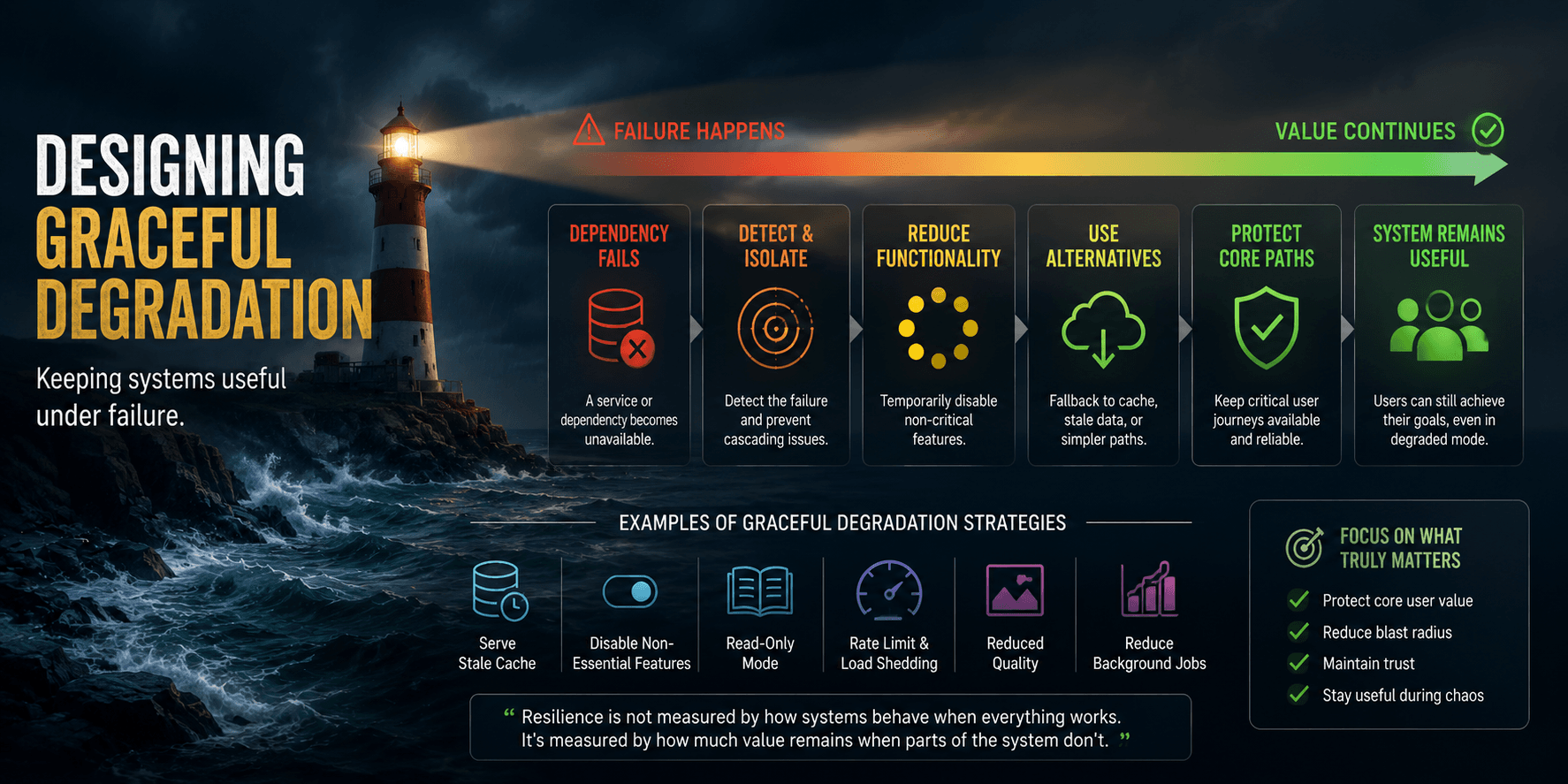
One of the biggest mistakes in software architecture is designing systems with only two states in mind:
- working
- broken
Reality is rarely that binary.
In production, systems often exist somewhere in between:
- slower than normal
- partially unavailable
- overloaded
- missing dependencies
- degraded but still recoverable
And this is where thoughtful architecture matters most.
Because resilient systems are not the ones that never fail.
They are the ones that:
👉 remain useful even while failing.
This is the idea behind graceful degradation.
⚠️ Failure Is Inevitable — Total Failure Is Optional
Distributed systems depend on many moving parts:
- databases
- caches
- third-party APIs
- queues
- identity providers
- payment systems
- recommendation engines
At some point, one of them will fail.
The question is not:
👉 “Can we avoid all failures?”
The question is:
👉 “How much functionality can we preserve when failure happens?”
🧠 What Graceful Degradation Actually Means
Graceful degradation means:
- reducing functionality intentionally
- preserving core user experience
- avoiding complete outages
Examples:
- showing cached content when live data fails
- disabling recommendations while checkout still works
- switching to read-only mode during database stress
- limiting non-critical features under heavy load
The goal is simple:
👉 Protect the critical path.
🛒 Real-World Example: E-Commerce
Imagine an online store.
During peak traffic:
- recommendation engine becomes slow
- analytics pipeline is overloaded
- image optimization service degrades
A fragile architecture:
👉 entire site slows down or crashes
A resilient architecture:
- recommendations disappear temporarily
- images load with lower quality
- analytics sampling is reduced
- checkout continues working
Users may notice degradation.
But they can still buy.
And in many businesses:
👉 preserving revenue paths matters more than preserving every feature equally.
🔥 Not All Features Are Equally Important
One of the most valuable architectural exercises is identifying:
Core features
Functions the business cannot survive without.
Secondary features
Useful, but not critical during incidents.
Optional enhancements
Nice-to-have experiences that can disappear temporarily.
This prioritization should happen:
- before incidents
- before scaling problems
- before outages
Because during a crisis, teams don’t have time to redesign priorities.
⚖️ Availability vs Experience
Graceful degradation is fundamentally a trade-off.
You sacrifice:
- completeness
- freshness
- performance
- visual polish
In order to preserve:
- availability
- responsiveness
- business continuity
Architecturally, this means accepting:
👉 partial functionality is often better than total failure.
🧩 Common Graceful Degradation Patterns
📦 Cached Responses
If a dependency fails:
- serve stale cache
- fallback to last known state
Especially useful for:
- product catalogs
- dashboards
- public APIs
Sometimes “slightly outdated” is acceptable.
“Unavailable” usually is not.
💤 Read-Only Mode
Under database stress:
- disable writes temporarily
- preserve read operations
Common in:
- financial systems
- reporting systems
- content platforms
This dramatically reduces pressure during incidents.
🎯 Feature Shedding
Disable:
- recommendations
- personalization
- search suggestions
- heavy analytics
Keep:
- authentication
- checkout
- core workflows
Protect the critical path first.
🚦 Rate Limiting & Load Shedding
When traffic exceeds capacity:
- reject low-priority requests
- limit expensive operations
- prioritize critical users
Not all traffic deserves equal treatment during failure.
📉 Reduced Quality Modes
Examples:
- lower image quality
- simplified UI
- reduced refresh frequency
- smaller payloads
Users often tolerate temporary quality reduction surprisingly well.
🧨 The Hidden Danger: Cascading Failure
Without graceful degradation:
- overloaded dependencies slow down
- retries amplify pressure
- queues grow indefinitely
- thread pools exhaust
- failures propagate
Soon:
👉 a small issue becomes a platform-wide outage
Graceful degradation acts as a pressure release valve.
🧠 The Hard Part: Business Decisions
Technical teams often assume graceful degradation is purely engineering work.
It isn’t.
Architects must collaborate with product and business stakeholders to answer questions like:
- Which features are truly critical?
- What can disappear temporarily?
- What data can become stale?
- How much inconsistency is acceptable?
- What user experience trade-offs are tolerable?
Resilience is ultimately:
- technical
- operational
- and business-driven
🛠 What Good Architects Do
Thoughtful resilience design includes:
✅ Dependency classification
Understanding which systems are critical.
✅ Explicit degradation plans
Not improvising during outages.
✅ Feature prioritization
Protecting the core user journey.
✅ Fallback mechanisms
Designing alternatives before they’re needed.
✅ Observability during degradation
Knowing:
- what was disabled
- why
- and for how long
🧭 Graceful Degradation Is About User Trust
Users are surprisingly forgiving of:
- temporary limitations
- reduced features
- slower updates
What they don’t forgive easily:
- total unavailability
- unpredictable behavior
- broken workflows
A partially functioning system communicates:
👉 “The platform is under stress, but still operational.”
That matters psychologically.
🧠 Final Thoughts
Graceful degradation is not about making systems perfect.
It’s about making failure survivable.
The best architectures are not the ones that avoid all incidents.
They are the ones that:
- adapt under pressure
- protect critical paths
- reduce blast radius
- and preserve usefulness during chaos
Because in distributed systems:
👉 surviving failure is often more important than preventing it completely.
📚 Related Reading
- Retries, Timeouts, and Circuit Breakers
- Failover Is Harder Than It Looks
- The Architecture Behind Outages: Why Big Systems Keep Failing
☕ Support the blog → Buy me a coffee
No spam. Just real-world software architecture insights.