Why Architecture Documentation Becomes Stale

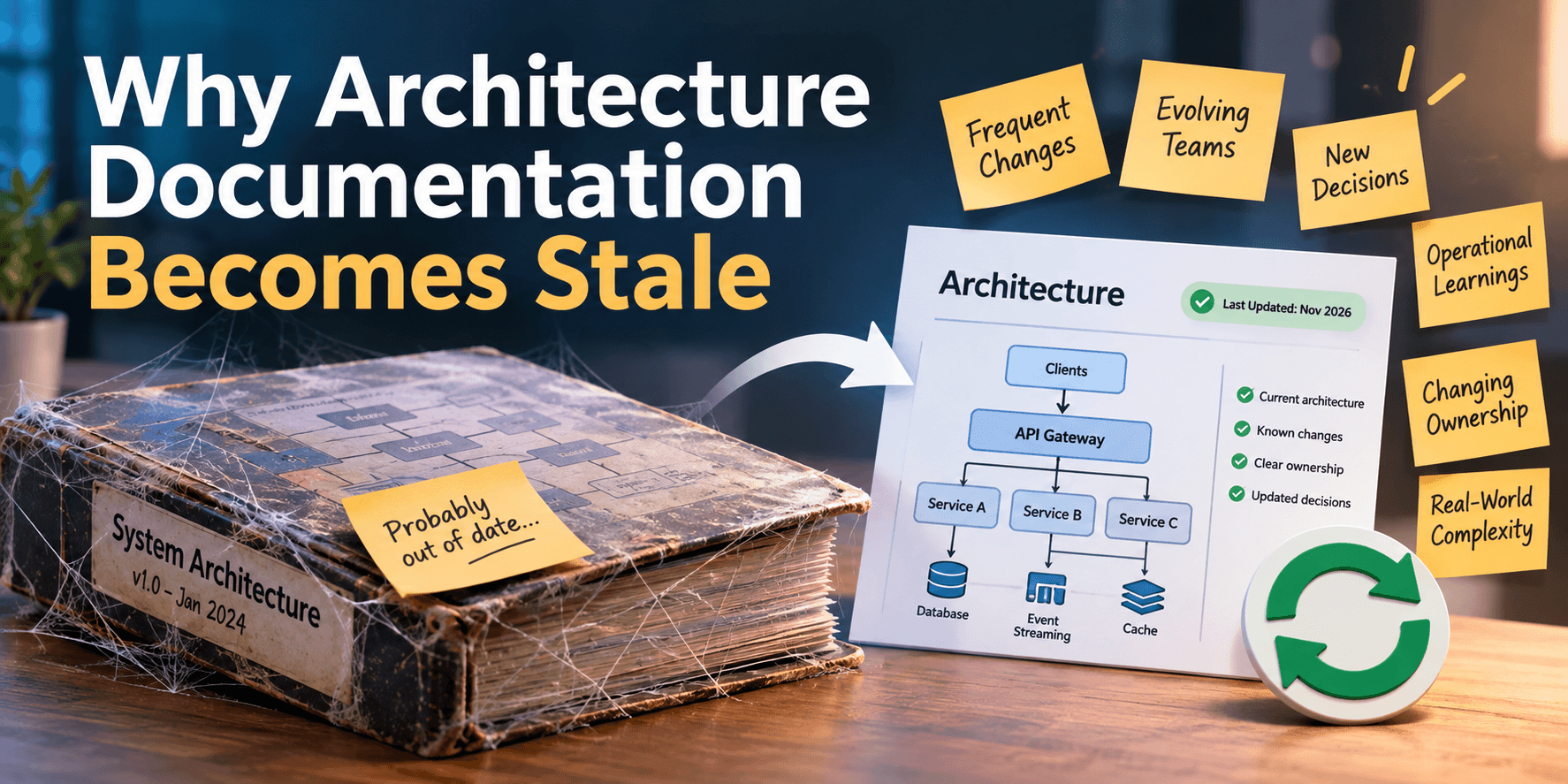
Architecture documentation has a reputation problem.
Ask engineers whether they trust the diagrams or design documents they find, and the answer is often some version of:
“I assume it is out of date.”
That assumption is understandable. A service diagram may show a system that was decomposed two teams ago. An ADR may explain a choice whose constraints no longer exist. A deployment guide may describe a path nobody has used since the last migration.
The usual explanation is that engineers do not document their work.
I think that is too simple.
Most teams create documentation with good intentions. The harder problem is that systems keep changing after the moment the documentation is written. The code evolves, the organization moves, dependencies change, and operational experience reveals things nobody knew at design time.
Documentation becomes stale when the organization has no reliable way to bring those changes back into the knowledge people use to make decisions.
This is not just a documentation problem. It is an architecture knowledge problem.
Documentation Is a Snapshot of a Moving System
Every architecture document describes the system as understood at a particular time.
That understanding may include:
- the components and boundaries that existed
- the people and teams responsible for them
- the constraints that shaped a decision
- assumptions about traffic, failure, cost, or behavior
- the future state the team expected to reach
Some of those facts change quickly. Others remain stable for years. A document can therefore be accurate in one part and misleading in another.
The difficulty is that a document rarely tells a reader which parts are still reliable. Without that signal, people tend to make one of two choices: trust it too much or ignore it entirely.
Neither is a good basis for an architectural decision.
Why Documentation Drifts
The system changes through many small decisions
Architecture rarely changes only through a major redesign. It changes incrementally as teams add endpoints, introduce caches, move workloads, split responsibilities, or work around production problems.
Each change may be reasonable on its own. But the cumulative result can differ substantially from the architecture described in a diagram created months earlier.
The documentation update is often treated as a separate task after the real work is complete. Under delivery pressure, that task is easy to defer. A small gap opens between the system and its description, and later changes build on top of it.
The people who know the context are busy changing the system
The engineers best placed to update a document are often the same people responding to incidents, delivering features, and maintaining the system. They know what changed, but may not have a clear moment or mechanism to record it.
When knowledge capture depends on someone remembering to return to a wiki after the work is done, it competes with every other priority. The system changes reliably; the explanation changes only when someone has spare attention.
Ownership changes faster than documentation
Teams reorganize. Services move between groups. A platform team takes over a shared capability. A product is retired or combined with another one.
Ownership information is often written down once and then left behind. When a document points to a team that no longer owns the system, readers lose a useful route to verification. They may stop trusting the rest of the information too.
Documents describe intended behavior, not always actual behavior
Design documents often capture what a system was meant to do. Production systems also contain workarounds, undocumented dependencies, operational limits, and behavior that emerged under real load.
An incident may reveal that a dependency cannot tolerate a certain request pattern. A migration may leave an old data path active longer than expected. A retry policy may interact with a downstream service in a way no design review anticipated.
If operational learning does not flow back into architecture knowledge, the document remains a description of intent rather than a useful account of the system.
Historical decisions are mistaken for current instructions
An ADR can be correct as a record of what a team decided at a particular time, even when its conclusion is no longer the right guidance today.
The problem appears when the status is unclear. A decision made under an old vendor limitation may continue to be treated as a rule after the limitation disappears. Readers cannot tell whether the document is historical context, current policy, or an open question.
Keeping history is valuable. Presenting history as current truth is not.
The repository is separate from the work
Architecture information may be spread across a wiki, source repositories, a service catalog, tickets, dashboards, and incident tools. Each source can be authoritative for a different kind of information.
But if people have to remember to update several places after one change, inconsistencies are likely. A new owner is recorded in the catalog but not the design page. A new dependency appears in code but not in the diagram. The problem is not necessarily that information is distributed; it is that the relationships and update paths are weak.
Stale Does Not Always Mean Useless
It helps to distinguish between information that is wrong and information that is old.
A historical decision can still explain why a system has an unusual boundary. An old migration plan can help someone understand how the current state came to exist. A retired service diagram may matter during an audit or incident investigation.
The risk comes when readers cannot tell what kind of information they are looking at.
A practical knowledge lifecycle can make the distinction visible:
- Current — verified and useful for present decisions.
- Under review — potentially useful, but a change or question needs validation.
- Superseded — retained for context, with a newer decision or description to follow.
- Retired — no longer applicable to current systems, but preserved as history where useful.
These labels do not guarantee accuracy. They give readers an honest starting point and a path to challenge what they find.
Not Every Document Needs the Same Freshness
Treating every document as if it needs constant review creates a large maintenance burden. Treating every document as permanent creates risk.
The effort should reflect two things: how quickly the information changes and what could happen if it is wrong.
| Information | Typical change rate | Consequence if stale |
|---|---|---|
| Service ownership | High | High |
| Deployment topology | High | High |
| Capacity limits | Medium to high | High |
| Business invariants | Low | Very high |
| Decision rationale | Low | Medium to high |
| Vendor comparison | High | Medium |
| Completed migration plan | High | Low to medium, if clearly historical |
This gives teams a more useful question than “When was this page last edited?”
Ask instead:
“How costly would it be if someone relied on this and it was wrong?”
A frequently changing service owner may need to be sourced directly from a catalog. A stable rationale may not need periodic rewriting, but should be revisited when a related decision is challenged. A capacity limit may need validation after a traffic shift or infrastructure change.
Freshness is a property of the information and its use—not simply the age of the page.
Make Change the Trigger for Knowledge Review
The most reliable time to check relevant documentation is when the system is already changing.
That does not mean every pull request should trigger a broad architecture review. It means teams should have lightweight prompts at the points where they are likely to discover that shared knowledge has changed.
For example:
- A service ownership change updates the service catalog and its architecture links.
- A significant boundary or dependency change prompts a check of the relevant diagram and decision records.
- An incident that disproves an assumption creates a follow-up to correct or challenge that assumption.
- A new platform constraint is connected to the affected systems and teams.
- A decision that replaces an earlier one marks the old decision as superseded.
These checks work best when they are part of the existing workflow. A short question in a change template—“Does this change invalidate any documented assumptions or relationships?”—can be enough to surface the issue.
The goal is not to make every code change produce architecture paperwork. It is to give teams a moment to notice when a change affects knowledge other people rely on.
Use Automation for Facts, People for Meaning
Some information can be kept current by deriving it from systems that already contain the facts.
For example, service names, repository links, deployment environments, and ownership contacts may be available from a service catalog or infrastructure metadata. Where possible, showing the authoritative source is safer than copying the same fact into several documents.
Other information requires judgment. A tool cannot reliably decide whether an old trade-off still applies, whether an assumption has been invalidated, or whether an incident changes the way teams should design a system.
Automation can identify likely drift:
- a link that no longer resolves
- a service that has no owner
- a diagram referencing a repository that has moved
- an ADR with no visible status
- a review date that has passed for high-risk knowledge
Those signals can help a person decide what needs attention. They cannot turn a stale explanation into a trustworthy one by themselves.
The Cost of Staleness Is Paid at Decision Time
Stale documentation often appears to be a small inconvenience. Someone asks around, checks the code, or schedules another meeting.
Repeated across an organization, that work becomes decision friction.
Teams may:
- repeat analysis because previous reasoning cannot be trusted
- delay a change while they reconstruct dependencies
- make conservative choices because the consequences are unclear
- follow an obsolete constraint that no longer applies
- miss a real constraint because the relevant knowledge is buried elsewhere
The cost is not measured by the number of outdated pages. It is measured by the time and risk involved in rebuilding context when a decision has to be made.
That is why a useful improvement begins with a few high-value questions. Choose an important system and identify the information people repeatedly need: its owner, key dependencies, significant decisions, operating limits, and unresolved assumptions. Then make sure there is a clear source, an owner or update path, and a way to flag when the information is challenged.
Start with the knowledge that is both consequential and hard to reconstruct. Improve that path before trying to refresh every document in the organization.
Final Thoughts
Architecture documentation becomes stale because the organization changes continuously while its knowledge practices often depend on occasional, manual updates.
The answer is not to demand more documents or schedule endless review cycles. It is to make important knowledge easier to validate when related work happens, distinguish current guidance from historical context, and focus maintenance where stale information could cause real harm.
Some information should be generated from authoritative sources. Some should be challenged after incidents or significant changes. Some should remain as history, clearly marked as such.
The larger goal is trust.
People should be able to tell what they can rely on, what needs verification, and where to go when the system no longer matches its description.
Architecture knowledge is not kept alive by writing it once. It stays useful when change has a path back into the organization’s shared understanding.
📚 Architecture Knowledge Series
- Architecture Knowledge: The Missing Discipline in Software Architecture
- Architecture Knowledge: The Operating Model That Turns Architecture Into a Discipline
Coming Next
- Tacit Architecture Knowledge: What Diagrams Cannot Capture
- Architecture Knowledge Graphs
- Decision Latency: The Hidden Cost of Fragmented Knowledge
- Architecture Knowledge Without Bureaucracy
☕ Support the blog → Buy me a coffee
No spam. Just real-world software architecture insights.